
.jpeg)


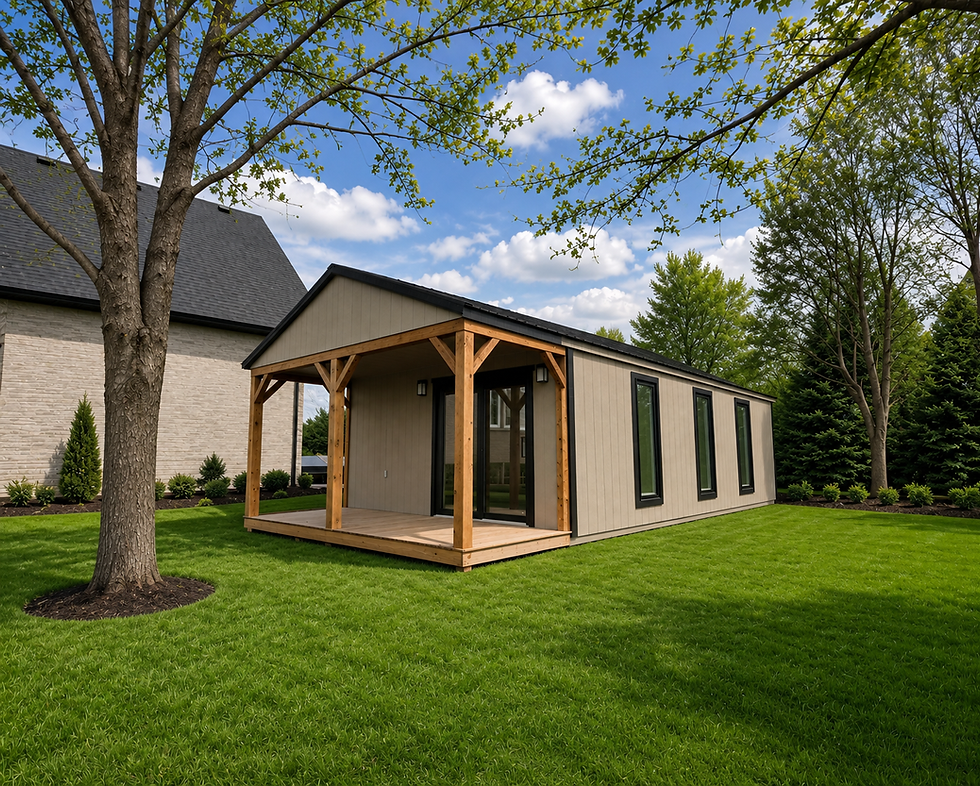
Tariffs & Timber: Why Your Next Backyard Shed Should Be 100% Canadian
This Isn’t About Politics. It’s About Where Your Money Goes.

After another turbulent weekend in Canada-U.S. trade relations, Canadians are once again hearing about tariffs, retaliation and uncertainty. Before you think this is going to be a Trump vs. Carney debate, it’s not. This is about something even closer to home: your money.
You've heard it before. Probably from someone around your grandfather's age. "Shop Canadian!", "Buy Canadian!", "Find the products with the Canadian flag on them!" For years we've been told that buying Canadian means paying more or sacrificing quality. Meanwhile, countries like China have become global manufacturing powerhouses, producing enormous quantities of goods at incredibly low costs.
But there's an even bigger question we should be asking:
Where does your money actually go after you spend it? I still have a distinct memory as a little 8 year old girl at my grandfather's house. We were all sitting around at dinner when the news came on in the background. In December of '03, Canada and China reached 7 new agreements. I remember my grandfather shouting, "This will be the end of Canada's economy!! Give it 10 years and everything you see being Made in Canada will say Made in China!!" Maybe he didn't get that entirely right but was he that far off?
The point isn't that Canada should stop trading with the rest of the world. That's neither realistic nor necessarily desirable. The point is that Canadians should understand where their money goes once they spend it.
Canada's Trade Relationships: A Lesson in Dependence
Just as Donald Trump's aggressive tariff threats and trade policies have strained Canada-U.S. relations and pushed Ottawa to look elsewhere, Canada in the early 2000s sought to balance its heavy economic reliance on Washington by actively expanding commercial ties with rising global powers like China. In December 2003, Canadian Prime Minister Jean Chrétien and Chinese Premier Wen Jiabao finalized seven new agreements aimed at strengthening economic cooperation between Canada and China. Commercial deals for Canadian wheat and potash were also finalized. At the time, Canada was looking to expand its international trade relationships and reduce its dependence on the United States.
More than two decades later, the circumstances feel surprisingly familiar. Donald Trump’s tariffs and increasingly unpredictable trade policies have once again exposed just how dependent Canada is on its southern neighbour. And once again, Canada is looking elsewhere. As tensions with the United States have grown, Ottawa has been working to strengthen trade relationships with countries including China and other global markets.
The difference is that this time, Canada isn't simply looking for new markets because it wants to diversify. It's being pushed to do so by the realization that putting too much of your economy in the hands of one trading partner can leave you vulnerable when that relationship changes.
Different leaders. Different strategies. Same lesson for Canada: economic dependence gives other countries leverage over us. To see how this dependence affects Canada in practice, we first need to take a closer look at the companies we consider Canadian, and what “Canadian” actually means.
“Canadian Company” vs. “Made in Canada”
Here's something many companies don't make especially clear when they describe themselves as a "Canadian company."
A company may be Canadian-owned and headquartered here, while its products contain materials, components, or labour sourced from outside Canada.
So let's break it down:
Canadian company = The business is Canadian-owned or operated, but its products may include materials or components sourced outside Canada.
Made in Canada = The product is manufactured in Canada, but that doesn't necessarily mean the company itself is Canadian-owned or operated.
Canadian-made = Generally communicates that the product is made here, but you should be careful about assuming that every material is Canadian.
Canadian company + Canadian-made = A stronger combination when both are genuinely true.
The distinction matters.
If you're intentionally trying to support Canadian businesses and workers, it is worth knowing what you're actually buying.
Buying Local Creates a Ripple Effect
Imagine spending $5,000 on a product manufactured entirely outside Canada. That money leaves the country, and very little of the economic activity surrounding that purchase may benefit Canadian workers or suppliers.
Now imagine making that same purchase from a Canadian company that employs Canadian workers, purchases from Canadian suppliers, uses Canadian transportation and contractors, and provides service locally. The purchase becomes part of a much larger economic chain.
Your purchase → Canadian business → Canadian employees → Canadian suppliers → contractors → transportation → service providers → Canadian communities.
That's the ripple effect.
The goal isn't to pretend every dollar can (or should) stay within Canada. That's not how a modern economy works. The goal is to recognize that the choices we make as consumers can influence which businesses grow, which jobs are supported, and where economic activity happens.
And let's be honest here. We're just the little guys in the grand scheme of things, taking on the big dogs within corporations. But our ability to create meaningful change starts at home.
From there it can ripple outward, strengthening our economy and making a difference on a much larger scale.
Why It Matters for Products That Last
A portable building isn't an impulse purchase. It's a significant investment that could sit on a property for decades. This is where the conversation becomes personal for us at Cedar Creek Structures. Quality craftsmanship matters when you're spending thousands of dollars. With Cedar Creek Structures, you can count on high-quality products whether it's a $3,000.00 project or a $33,000.00 build.
So why not invest in something built by people in your own country?
Why shouldn't craftsmanship matter?
Why shouldn't you know who built it?
Why shouldn't you know where it was built? And why shouldn't you have the option to invest your own money where you want without limited finances automatically determining your decision? There's another consideration, too.
Canada’s climate is vastly different from that of our southern neighbours and many other countries. What works elsewhere doesn’t always work here. Products and infrastructure need to be designed with our harsh winters, extreme temperature swings, snow, and ice in mind, because they simply aren’t accustomed to building for the conditions we face. Remember when Tesla vehicles first arrived in Ontario?
When you're purchasing something that may sit outside through years of Canadian winters, design and durability absolutely matter.
Canadian Doesn't Have to Mean Compromising
Buying Canadian doesn't have to mean settling for less. It can mean choosing quality, accountability, local craftsmanship, and a company that stands behind what it builds.
There are several ways that matters right now.
Strengthening Canada's Economic Resilience
Canada has enacted retaliatory tariffs against incoming U.S. goods in response to Washington's trade policies.
Regardless of where you stand politically, one thing is clear: the more resilient our domestic economy is, the better positioned Canadian businesses and consumers are to withstand economic shocks. Buying Canadian helps keep money circulating within the domestic economy and gives local businesses an opportunity to grow.
Supporting Canadian Farmers and Producers
Trade disputes don't only affect large corporations.
They can have a significant impact on Canadian farmers, manufacturers, producers, and families whose livelihoods depend on access to markets. When you choose Canadian food, agricultural products, and other locally produced goods, you're supporting the people behind those products.
Building More Independent Supply Chains
The current trade environment has demonstrated how vulnerable countries can become when they rely too heavily on foreign powers for essential goods.
Supporting Canadian manufacturing and production gives businesses more reason to invest in domestic capacity. A stronger domestic supply chain means Canada has more options when international trade becomes uncertain.
Choosing Canadian doesn't mean settling for less. It means choosing quality, accountability, and a company that stands behind what it builds.
Your Next Purchase Is a Choice As Canadians, we can't control every tariff, trade negotiation or political decision that happens within our country, but we can choose where we invest our hard-earned money. Every purchase is a choice.
You can choose based solely on price. Or you can consider the bigger picture:
Who built it?
Where was it built?
Who does your purchase support?
Where does your money go after you spend it?
At Cedar Creek Structures, being Canadian isn't just something we put on a sign or mention in our marketing to entice people. It's the core of why our CEO started our company in the first place.
Cedar Creek Structures is a proudly Canadian company, building portable structures right here in Ontario and working with local people, suppliers, and communities. When you choose Cedar Creek, you're not just buying a shed or portable building, you're choosing to put your money back into Canadian jobs, Canadian families, and Canadian communities.
We believe you should know where your money goes and feel good about where it ends up.
So, when you're ready for your next portable building, choose a company that is Canadian through and through, like Cedar Creek Structures.
We build it here. It's backed here. And we are unapologetically and ever so proudly Canadian! 🇨🇦

Comments